The Gruel That Feeds 2026
A single dish, cooked once, to eat for several days.
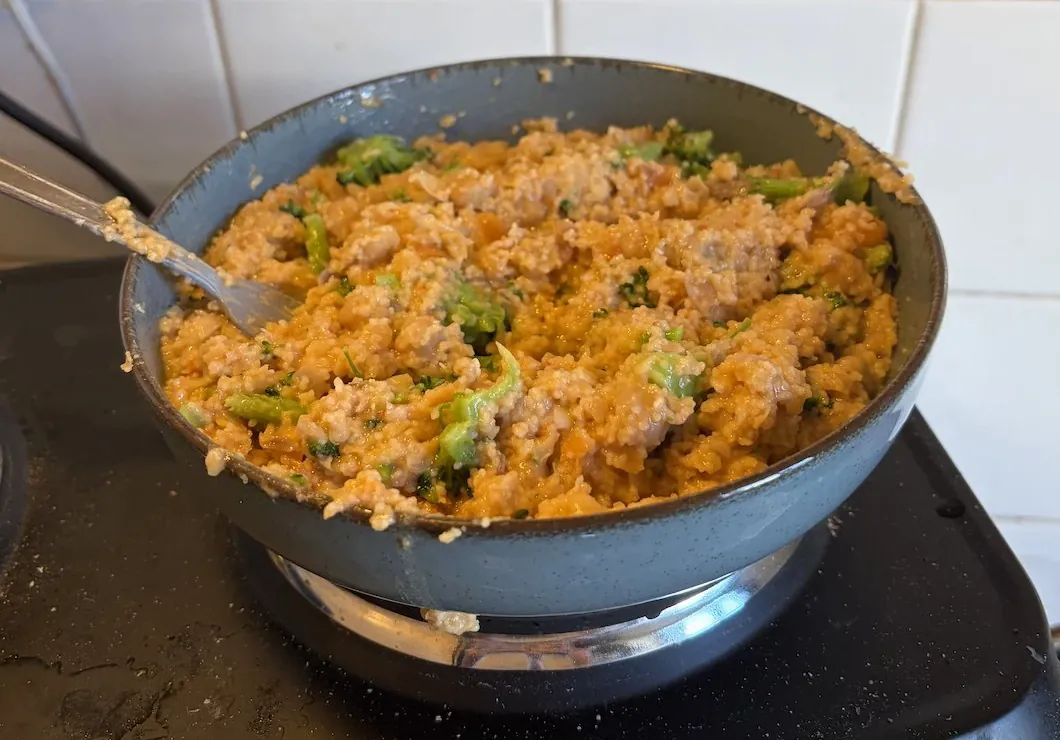
1Goal
The Gruel That Feeds 2026 is the healthiest and cheapest dish available in France (/day). It covers of the 25 daily nutritional needs (with ~ kcal/day) using the cheapest ingredients available. The whole thing rests on complex, verified mathematical models.
My cookware
Volumes are to the brim. The page only fills for simmering and for browning. The stockpot is assumed to be 5 L: correct it if needed.The two saucepans are assumed to be 2 L and 1.5 L, the frying pans 1.8 L and 1.4 L: correct them if needed.
- kcalper day
- kcalper meal, over meals
- kcalper tub
- per day
- per meal
- / 25needs met
A “tub” is a portion put in the fridge. The full meal adds the semolina, the vegetable, the yoghurt, and the egg or the sardines: hence the gap between the two figures.
2Ingredients
For , or bowls: .
The bowl
The first trip through the checkout costs about : you pay for whole packs, which will serve the next . Supermarket own-brand prices in France, recorded in 20269.
Where the money goes, per day
3Recipe
Each bowl, 10 minutes
Food safety
In the fridge within 2 h, at 4 °C. Three days, not one more; the rest goes in the freezer from the first evening. One tub, one single reheating, until it bubbles. Reheating does not rescue a dish that was left out too long10. Opened sardines: in a closed container, cold, two days if possible.
4Why each ingredient is there
Nothing is decorative. Not even the liver.
The quantities come out of a minimum-cost calculation on the prices and compositions of Nutrition per euro, then are rounded by hand. A box is ticked when a day provides at least 100% of the need2.
/ 25
Two boxes stay empty in the reference recipe. Vitamin D (%): the body makes it mostly in sunlight, and almost no dish provides enough. Selenium (%): it would take more fish. Zinc scrapes through at %: it is tight, and almost any substitution sinks it.
The ingredients
| Chickpeas, red lentils | Protein, iron and fibre, among the cheapest in the shop. Red lentils break down and bind the sauce. |
| Onions, carrots, tomato purée, garlic, cumin, smoked paprika | The flavour. It is the base of a harira: onions browned for a quarter of an hour, tomato fried until it darkens. |
| Rolled oats | They thicken and bring zinc and magnesium. |
| Brewer's yeast | B vitamins and zinc, for a day. Without it: needs out of 25. |
| A chicken liver | The body absorbs the iron in dried pulses poorly. With the liver, mg absorbed per day, against a need of 11. Without it, . It accounts for % of the iron eaten and % of the iron absorbed. a day. |
| Semolina | Most of the bowl's calories ( kcal). It stays out of : three days in a sauce, and a starch turns into a block. |
| Frozen broccoli | Vitamin C and calcium. Added to the bowl, the calculation leaves it % of its vitamin C; , after three days in the cold, %. |
| Yoghurt | Calcium, iodine, vitamin B2. Cold and sharp on a hot bowl: it is also what helps the rest go down. |
| Sardines, egg | Fish omega-3, vitamin B12, and the little vitamin D the dish has. The bones count towards the calcium. |
| Rapeseed oil | The plant omega-3: % of the need, no more. A third stays raw. |
| Iodised salt, for three days | Ceiling: 6 g a day, glutamate included. Spread over kg of food, that makes g per 100 g, half as much as a shop-bought soup5. Hence the next line. |
| Glutamate | Flavour without salt. In a trial of 584 people, a lightly salted water goes from 31 to 61 out of 100 when it is added6. Dose: g a day, or mg per kilo at 70 kg, under the European limit of 307. |
| No spinach | The best-rated food in the ranking, turned away all the same. 200 g a day would push urinary oxalate to between mg a day, above the alert threshold of (kidney stones)3. With the gruel: . They also concentrate cadmium4. |
The steps
| Chickpeas cooked alone, without tomato | Acid stops them softening. The tomato and the vinegar go in once they crush easily. |
| The base browned separately | Nothing browns in water. Fifteen minutes in the pan make the difference between a sauce and cooking water. |
| Lentils and oats at the end | A quarter of an hour is enough for them. They thicken fast and stick: keep stirring. |
| Yeast off the heat | Its B vitamins do not stand boiling well. |
| Shallow tubs | To cool in under two hours, and to reheat only what you eat. |
| Semolina at the last moment | It soaks up the water in four minutes. The third day is as good as the first. |
| A pinch of salt on the surface | Placed on top, the salt hits the tongue straight away: less is needed for the same effect8. |
5Substitutions
Just in case. Every deviation has a price, usually paid in zinc.
Tick a row: the ingredients, the recipe, the calories and the needs are recalculated. Differences are given per day, against the reference recipe.
6Two comparisons
The 2017 gruel
In 2017, an internet user published the “bouillie qui nourrit” (the gruel that nourishes): for three days of food, dog food included1. The whole pot holds about kcal, which is less than a single day. It was a fast with a smell.
| 2017 | 2026 | |
|---|---|---|
| Taste | NO“emetic reputation”1 | YESbrowned onions, tomato, garlic, cumin |
| Texture | NO“gloopy”1 | YESfresh semolina in every bowl |
| Nutrition | NO kcal a day | YES kcal, needs out of 25 |
| Price | HALF, for less than a day | YES a day |
A concession. Per 1,000 kcal, the 2017 pot provided more zinc than the 2026 gruel: about mg against . Probably the additives in the dog food. Good dog.
Nutraloaf
Some American prisons serve, as a punishment, a loaf into which a whole meal has been blended, supposed to be nutritionally complete12. The same idea as the gruel, the opposite intention. The only costed recipe found, Fairfax County's13, put through the same calculation:
| Per day | Nutraloaf | Gruel 2026 |
|---|
No meat, no fish, no milk: no vitamin B12 at all. Twice the salt ceiling, a dozen sugar cubes, and spinach. Less zinc than the dog food ( mg per 1,000 kcal). And it is not even cheaper.
7Good to know before you start
- Go easy: g of fibre a day is times the need. Build up over two weeks, or your stomach will let you know.
- It is not a diet for life: vitamin D and selenium fall short, and the salt is at the ceiling. Vary your food.
- Get medical advice before making it a regular dish if you are pregnant (liver), if you have high blood pressure, kidney stones or kidney disease, or if you take a vitamin K antagonist anticoagulant. Not for infants or young children.
- Under 52 kg: use a third less glutamate.
- Allergens: gluten, milk, egg, fish.
Work by basedpolymer. It has been reviewed by neither a nutritionist nor a peer. It is not medical or dietary advice.
8Method and sources
The method, for the curious
- Calculation: CIQUAL 2025 compositions, prices and absorption factors from Nutrition per euro. Vitamin losses counted: three days in the cold then reheating for , reheating alone for the bowl. Energy: g of protein, g of carbohydrate, g of fat (% of the energy, below the 35 to 40% ceiling of ANSES), g of fibre.
- Needs: valid if everything is eaten; if only 90% of the bowls are eaten, out of 25 remain. Zinc only just at the target, which is set for 900 mg of phytates: the real margin is probably negative. Selenium: some of the CIQUAL values are below the detection limit. B3 counted with tryptophan.
- Iron: absorption estimated at between 1 and 1.5 mg a day depending on the model, for a median need of in a menstruating woman. The yoghurt in every bowl may slow it.
- Oxalate: 1.3 to 2.0 g a day with 200 g of spinach according to the table, 0.18 g in the recipe. Mitchell 2019 slope extrapolated beyond the doses tested.
- Salt and glutamate: g of salt a day, glutamate sodium included. The glutamate trial was run in solution, at a dose three times stronger than the bowl's.
- Price: a day, of which for salt, spices, garlic, vinegar and glutamate. From €2.49 to €4.47 if all the prices move by 30%. Electricity adds about €0.13 a day. The pack sizes of the substitutes are estimated from their price per kilo.
- Volumes: g of water taken up in soaking per gram of chickpeas, g evaporated during cooking for three days, finished gruel at kg per litre. These are assumptions, not measurements: keep a margin.
- 2017 and nutraloaf: 2017 calories and zinc estimated without a verified label. Nutraloaf: Fairfax recipe for 60 portions, one portion per meal, cups converted to grams, French prices partly estimated. Other prisons add meat or milk.
- JVFlux, Bouillie qui nourrit, 2017 recipe.
- EFSA and ANSES reference values, as used in Nutrition per euro.
- Mitchell T et al. Am J Physiol Renal Physiol 2019;316(3):F409-F413, doi. Brogren M, Savage GP. Asia Pac J Clin Nutr 2003;12(2):219-224, PDF. Table OHF, 2024.
- BfR, Opinion 030/2026. EFSA, Cadmium in food, EFSA Journal 2009;980.
- CIQUAL 2025, ANSES: median of ready-made soups, 0.65 g of salt per 100 g.
- Hayabuchi H et al. Hypertens Res 2020;43(6):525-533, doi.
- EFSA ANS, EFSA Journal 2017;15(7):4910, doi.
- Noort MWJ et al. J Cereal Sci 2010;52:378-386 and 2012;55:218-225. Effect measured on bread.
- basedpolymer, Nutrition per euro, 2026.
- ANSES, fact sheets Bacillus cereus and Hygiène domestique (in French).
- EFSA NDA, EFSA Journal 2015;13(10):4254. Armah SM et al. J Nutr 2013;143(7):1136-1140. Hallberg L et al. Am J Clin Nutr 1991;53(1):112-119.
- Wikipedia, Nutraloaf, accessed 2 November 2026.
- Lithwick D. “Loaf Without Parole”. Slate, 23 December 2002, article.